

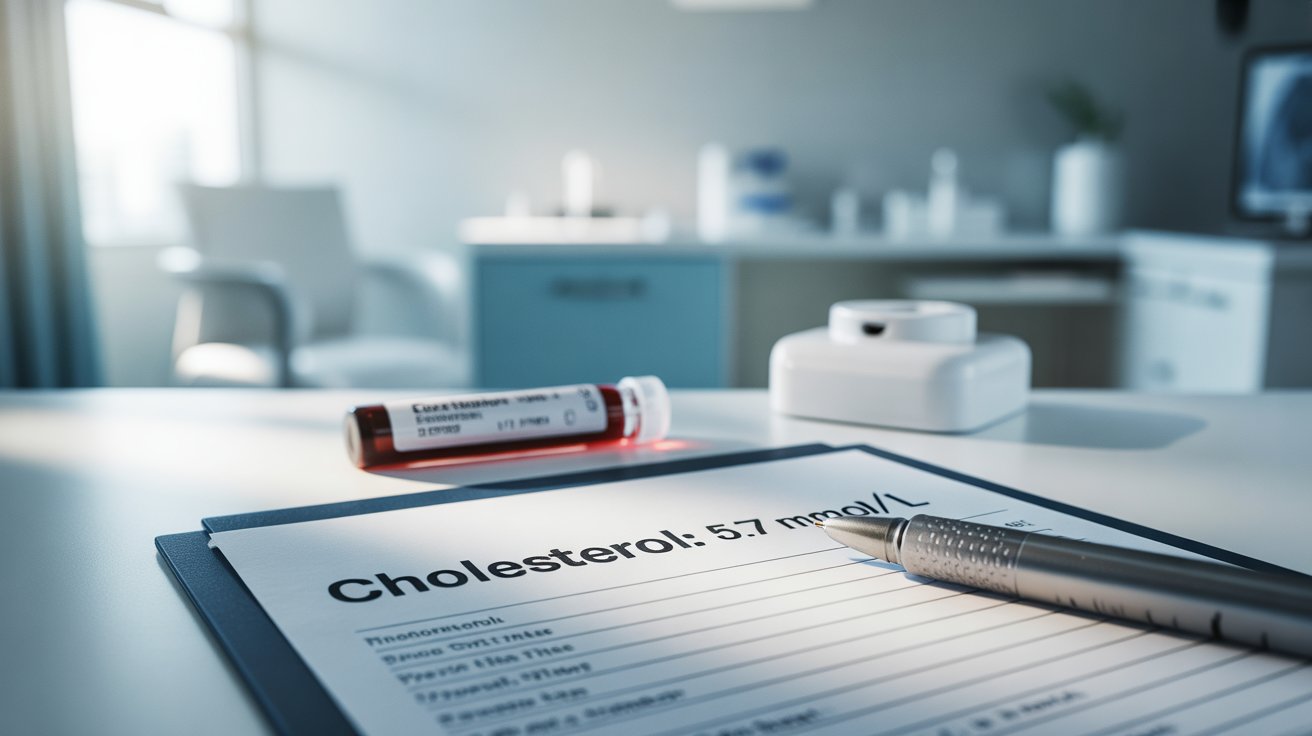
You have had a cholesterol test and your result has come back as 5.7 mmol/L. You know the headline target is 5.0, so you are wondering whether 5.7 is something to worry about — and, if so, what to do about it. The answer requires a little context, because a total cholesterol figure of 5.7 on its own tells you less than you might think. Here is what a GP would actually say about a cholesterol level of 5.7 in the UK — including what it means, what it does not mean, and when it is and is not cause for clinical concern.
What Is the Target Cholesterol Level in the UK?
In the UK, cholesterol levels are measured in millimoles per litre (mmol/L). The government and NHS guidance — aligned with recommendations from Heart UK, the British Heart Foundation, and NICE — is that healthy adults should aim for a total cholesterol level below 5.0 mmol/L. This threshold is not arbitrary: it reflects the evidence base linking elevated total cholesterol to increased cardiovascular risk at a population level.
However, it is important to understand that 5.0 mmol/L is a general population target, not a hard clinical cut-off. Three in five adults in the UK have a total cholesterol at or above 5.0 mmol/L, meaning 5.7 places you in a range that is above ideal but also extremely common. Whether a level of 5.7 requires treatment — or simply attention and lifestyle modification — depends on a set of factors that go well beyond the total cholesterol number itself.
So Is 5.7 mmol/L Considered High?
A total cholesterol of 5.7 mmol/L is above the ideal UK target of 5.0 mmol/L and sits in the range that clinicians generally describe as mildly to moderately elevated. It is not in the range associated with severely elevated cardiovascular risk on its own — levels above 7.5 mmol/L, for example, raise the possibility of familial hypercholesterolaemia, an inherited condition requiring specialist assessment. But 5.7 is above where most guidelines would like to see you, and it warrants a proper clinical review.
What 5.7 does not do, on its own, is tell you very much about your actual cardiovascular risk. Two people can both have a total cholesterol of 5.7 mmol/L and have very different risk profiles. A 35-year-old non-smoking woman with no family history of heart disease, good HDL cholesterol, and a low LDL may have a ten-year cardiovascular risk that is entirely acceptable despite a total cholesterol of 5.7. A 55-year-old man with high blood pressure, type 2 diabetes, a family history of premature heart disease, and an LDL of 4.1 mmol/L with the same total cholesterol figure faces a meaningfully different clinical picture. The number without the context is only half the story.
What the Other Components of Your Cholesterol Test Tell You
A total cholesterol of 5.7 mmol/L is a starting point, not a conclusion. The most clinically important information comes from the breakdown of the lipid profile — specifically the LDL, HDL, and non-HDL cholesterol values, and the ratio of total cholesterol to HDL.
LDL Cholesterol (Low-Density Lipoprotein)
LDL is the primary driver of atherosclerotic cardiovascular disease and the main target of cholesterol-lowering treatment. NICE guidance for the UK sets an LDL target of 3.0 mmol/L or below for primary prevention in healthy adults, and 2.0 mmol/L or below for those with established cardiovascular disease or at high risk. For someone with a total cholesterol of 5.7 mmol/L, the LDL component is the most important number to examine. If your LDL is, say, 3.6 mmol/L, that is more clinically significant than the total cholesterol figure alone. If LDL is above 4.9 mmol/L alongside a family history of premature heart disease, familial hypercholesterolaemia (FH) should be considered.
HDL Cholesterol (High-Density Lipoprotein)
HDL carries cholesterol away from the arteries and back to the liver for processing, and higher levels are generally protective. Heart UK recommends an HDL of above 1.2 mmol/L for women and above 1.0 mmol/L for men. An important nuance: a high HDL can make your total cholesterol look elevated even when your cardiovascular risk is actually low. If your total cholesterol is 5.7 mmol/L and your HDL is 1.9 mmol/L — reflecting a strong, protective HDL — your total cholesterol:HDL ratio may be within an acceptable range despite the elevated total figure. Conversely, a low HDL alongside a total cholesterol of 5.7 significantly increases cardiovascular risk.
Non-HDL Cholesterol
Non-HDL cholesterol — total cholesterol minus HDL — captures all the atherogenic (artery-narrowing) lipid particles in a single figure and is the primary treatment target in NICE’s NG238 lipid guidelines for the UK. The non-HDL target for primary prevention is 4.0 mmol/L or below. For someone with a total of 5.7 and an HDL of 1.4 mmol/L, non-HDL would be 4.3 mmol/L — mildly above target. For someone with the same total and an HDL of 1.8 mmol/L, non-HDL would be 3.9 mmol/L — within target. This is why the full lipid profile matters, not just the headline number.
Total Cholesterol:HDL Ratio
NICE NG238 recommends the use of the total cholesterol:HDL ratio to estimate ten-year cardiovascular risk using the QRISK3 calculator. A ratio of 4.0 or below is generally considered low risk; above 6.0 indicates significantly elevated cardiovascular risk. For a total cholesterol of 5.7 mmol/L, the ratio depends entirely on your HDL level — which is why seeing the full breakdown of your result is essential before drawing any clinical conclusion.
Your QRISK3 Score: The Number That Actually Matters
In UK clinical practice, no cholesterol result is interpreted in isolation. NICE guidance requires the use of QRISK3 — a validated cardiovascular risk calculator — to estimate the probability of a heart attack or stroke over the next ten years. QRISK3 incorporates total cholesterol:HDL ratio alongside a comprehensive set of additional risk factors: age, sex, blood pressure, BMI, smoking status, family history, ethnicity, deprivation, diabetes, chronic kidney disease, atrial fibrillation, rheumatoid arthritis, and several other variables.
A QRISK3 score of 10% or above — meaning a 10% or greater probability of a cardiovascular event in the next ten years — is the threshold at which NICE recommends considering statin therapy for primary prevention. A total cholesterol of 5.7 mmol/L contributes to this score, but it is one input among many. Two people with identical cholesterol can have QRISK3 scores of 3% and 18% respectively, based on the other variables in their profile. This is why a GP assessment — not a cholesterol number in isolation — is what determines whether and how treatment is warranted.
What Should You Do If Your Cholesterol Is 5.7 mmol/L?
If you have not yet had a full lipid profile
A total cholesterol figure from a pharmacy finger-prick test or an at-home kit, without the accompanying LDL, HDL, non-HDL, and triglyceride values, is insufficient for a proper clinical assessment. A full fasting cholesterol blood test — a venous draw processed by an accredited laboratory — gives the complete picture. If you only have a total figure, getting the full panel is the logical first step.
If you have the full lipid profile
A face-to-face GP consultation is the right next step. Your GP will review your full lipid profile, calculate your QRISK3 score, assess your blood pressure, BMI, family history, and any other relevant risk factors, and advise whether lifestyle modification alone is sufficient, whether repeat testing in three to six months is appropriate, or whether cholesterol-lowering medication is indicated. This is not a conversation that can be had meaningfully with a number alone.
Lifestyle changes that can lower a cholesterol of 5.7 mmol/L
For many people with a total cholesterol of 5.7 mmol/L and a low to moderate overall cardiovascular risk, lifestyle modification can bring levels down meaningfully without medication. Evidence-based changes include:
- Reducing saturated fat: Replacing butter, full-fat dairy, fatty meat, and processed foods with olive oil, lean protein, oily fish, nuts, and plant-based fats. The British Heart Foundation estimates that reducing saturated fat intake can lower LDL cholesterol by up to 10%.
- Increasing soluble fibre: Oats, barley, pulses, lentils, and fruit such as apples and pears contain soluble fibre that binds to cholesterol in the gut and reduces its absorption. Daily oat consumption is one of the most consistently evidenced dietary interventions for LDL reduction.
- Regular aerobic exercise: 150 minutes of moderate aerobic exercise per week — brisk walking, cycling, swimming — raises HDL, lowers triglycerides, and modestly reduces LDL. Data from Forth’s analysis of 24,000 UK blood tests confirms that exercise above six hours per week is associated with meaningfully higher HDL levels.
- Reducing alcohol: Alcohol raises triglycerides and, in excess, can increase total cholesterol. Reducing intake below the recommended 14 units per week — ideally lower — has a measurable effect on the lipid profile.
- Plant sterols and stanols: Foods fortified with plant sterols or stanols — available in many supermarkets — are clinically evidenced to reduce LDL by 7 to 10% when consumed daily in the appropriate quantities. They are a practical, non-pharmaceutical addition for motivated patients.
- Weight management: Excess weight, particularly abdominal fat, is strongly associated with elevated triglycerides and low HDL. Even modest weight reduction — 5 to 10% of body weight — can produce meaningful improvements in the lipid profile.
When Is a Cholesterol of 5.7 More Urgent?
A total cholesterol of 5.7 mmol/L warrants more urgent clinical attention if any of the following apply:
- Your LDL is above 4.9 mmol/L — particularly with a family history of early heart disease, which raises the possibility of familial hypercholesterolaemia
- You have established cardiovascular disease, previous heart attack, stroke, or TIA — in which case the LDL target is 2.0 mmol/L and treatment is likely already indicated
- You have diabetes, hypertension, chronic kidney disease, or another condition that independently elevates your cardiovascular risk
- You are a man over 50 or a postmenopausal woman — cardiovascular risk rises with age, and 5.7 mmol/L carries greater significance at 60 than at 35
- Your QRISK3 score is 10% or above when calculated with your full clinical profile
If any of these apply to you, a same-day private GP consultation at The Private GP Birmingham is the most direct route to a complete assessment and a clear clinical plan. Same-day appointments are available, with same-day blood testing for the full lipid panel, HbA1c, thyroid function, kidney and liver function, and any other markers relevant to your cardiovascular risk profile.
Frequently Asked Questions
- Is a cholesterol level of 5.7 high in the UK?
A total cholesterol of 5.7 mmol/L is above the UK general population target of 5.0 mmol/L and is considered mildly to moderately elevated. It is not severely high — levels above 7.5 mmol/L are of greater concern for inherited conditions such as familial hypercholesterolaemia — but it is above where current guidance would like to see most adults and warrants a proper clinical review. Whether it requires treatment depends on your full lipid profile, QRISK3 cardiovascular risk score, and individual health history.
- What should my cholesterol be in the UK?
UK guidance from the NHS, Heart UK, and NICE recommends a total cholesterol below 5.0 mmol/L for healthy adults. LDL should ideally be below 3.0 mmol/L for primary prevention, and below 2.0 mmol/L for those with established cardiovascular disease. HDL should be above 1.2 mmol/L for women and 1.0 mmol/L for men. Non-HDL cholesterol should be below 4.0 mmol/L for primary prevention. However, these targets are guides — your GP will determine the most appropriate targets for you based on your full clinical picture and QRISK3 score.
- Do I need a statin if my cholesterol is 5.7?
Not necessarily. Whether a statin is indicated depends on your full lipid profile, your QRISK3 ten-year cardiovascular risk score, and your individual risk factors — not the total cholesterol figure alone. NICE recommends considering statin therapy for primary prevention when QRISK3 reaches 10% or above. Many people with a total cholesterol of 5.7 mmol/L and a low to moderate overall risk profile can achieve meaningful improvement through diet and lifestyle changes without medication. A face-to-face GP assessment is the only reliable way to determine whether treatment is clinically appropriate for you.
- Can diet bring my cholesterol down from 5.7?
Yes — for many people with a total cholesterol of 5.7 mmol/L, dietary and lifestyle modification can produce a meaningful reduction without medication. Reducing saturated fat, increasing soluble fibre (particularly oats and pulses), incorporating plant sterols and stanols, increasing aerobic exercise, reducing alcohol, and managing weight can collectively lower LDL cholesterol by 10 to 20% in motivated patients over three to six months. The effect varies between individuals. A GP review after three to six months of lifestyle change allows assessment of whether the response has been sufficient or whether medication should be considered.
- What is the total cholesterol:HDL ratio for a cholesterol of 5.7?
The total cholesterol:HDL ratio for a cholesterol of 5.7 depends on your HDL level, which varies between individuals. If your HDL is 1.4 mmol/L, the ratio is 4.1 — mildly above the 4.0 target used in QRISK3 risk assessment. If your HDL is 1.9 mmol/L, the ratio is 3.0 — within a healthy range. This illustrates why the full lipid profile matters so much more than the total figure alone. At The Private GP Birmingham, a full fasting cholesterol panel with GP results review gives you all the components needed for a clinically meaningful assessment — not just a total number.