

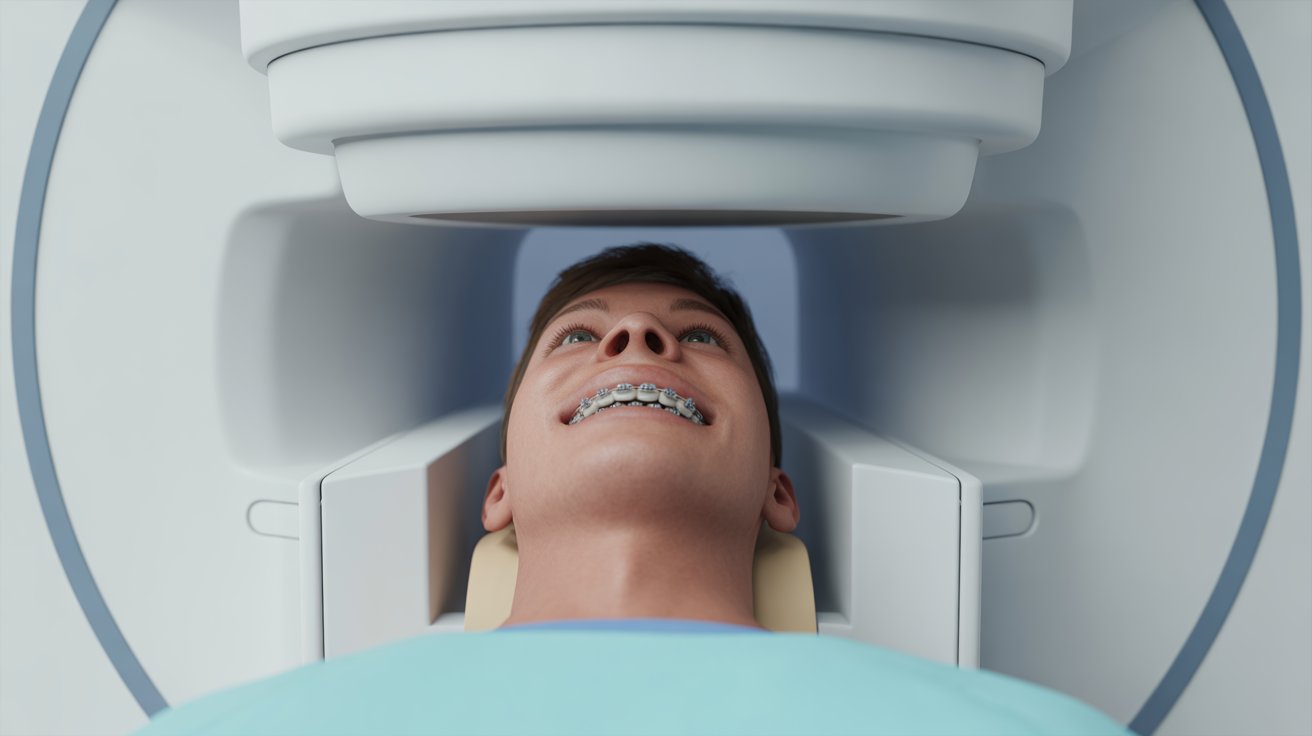
Being referred for an MRI when you have braces is understandably confusing — the whole premise of the scan involves powerful magnets, and braces are made of metal. But the reassurance is straightforward: having braces does not prevent you from having an MRI.
Here is what you need to know before your appointment.
Is It Safe to Have an MRI With Braces?
Yes. Modern orthodontic braces are made from non-ferrous metal alloys — meaning they are not strongly attracted to magnets. They will not be pulled out of your mouth by the scanner, and they will not cause significant harm during the scan.
A clinical review published in the British Dental Journal confirms that orthodontic brackets are considered MRI-safe, though their proximity to the area being scanned can cause image artefact. The concern with braces is not patient safety — it is image quality near the mouth.
MRI Questions, a reference resource used by radiologists, confirms that metal orthodontic devices such as archwires and palate expanders can undergo some radiofrequency heating during a scan, but at levels far below the threshold that would cause pain or injury to the mouth or surrounding tissue.
That said, Princess Alexandra Hospital NHS Trust advises patients with fixed braces to contact the MRI department before their appointment. This is standard practice — not because the scan cannot go ahead, but so the team can plan appropriately and flag the potential for image distortion near the mouth.
Will Braces Affect the MRI Images?
Possibly — but it depends on which part of your body is being scanned.
The British Dental Journal review notes that metal orthodontic appliances are known to cause magnetic field distortions and signal loss, resulting in artefact on the images. In plain terms, the area close to the braces may appear blurred or distorted on the scan.
Zainab Clinics’ dental MRI safety guide explains that for scans of the brain, jaw, or sinuses — areas close to the mouth — the chances of image distortion are high and the radiologist needs to be aware. For scans of the abdomen, spine, knee, or lower limbs, braces are unlikely to affect the results at all.
Your radiologist will account for any artefact when reporting the images. In cases where a brain or jaw MRI is significantly affected, the team may discuss whether a repeat scan or alternative imaging is needed.
Does the Type of Brace Matter?
Yes. Different brace types have different implications for MRI.
Metal braces are the most common type and the most likely to cause image artefact near the mouth. They are still considered safe for scanning, but the MRI team should always be informed.
Ceramic braces are made from tooth-coloured ceramic material, which is non-metallic. They cause little to no interference with MRI images and are generally easier to scan with.
Clear aligners (such as Invisalign) are made entirely from plastic. They pose no problem for MRI and should be removed before entering the scanning room, as they sit loosely over the teeth.
Lingual braces — fitted to the back of the teeth — are made from similar metal alloys to standard braces and carry the same considerations. Declare them to the MRI team in the same way.
Do You Need to Tell the MRI Team About Your Braces?
Yes, always — regardless of which part of your body is being scanned.
Royal Devon University Healthcare NHS Foundation Trust’s MRI preparation guidance lists having a dental brace fitted as one of the conditions requiring patients to call the MRI department before attending. Princess Alexandra Hospital NHS Trust echoes this, asking patients with fixed braces to contact the department in advance.
This does not mean the scan will be refused or delayed. It simply allows the radiographer and reporting radiologist to prepare — noting that some artefact may appear near the mouth and adjusting their interpretation accordingly. Telling them in advance avoids any last-minute uncertainty on the day.
When you call or arrive, let the team know:
- That you have fixed braces (or a fixed retainer)
- Which type — metal, ceramic, or lingual
- Which area of your body is being scanned
From there, the team will confirm whether any additional steps are needed.
What About Retainers and Clear Aligners?
Removable retainers and clear aligners should be taken out before entering the MRI scanning room. They are not a safety risk, but removing them is standard practice for any loose items in or around the mouth before a scan.
Fixed retainers — the thin wire bonded to the back of the front teeth after orthodontic treatment — are treated in the same way as fixed braces. They are considered MRI-safe, but you should declare them to the MRI team before your appointment. For most body scans, a fixed retainer causes no practical problem whatsoever.
Frequently Asked Questions
- Will my braces be pulled out during an MRI?
No. Modern orthodontic braces are made from non-ferrous alloys that are not strongly attracted to the MRI magnet. There is no risk of them being pulled out during the scan.
- Do I need to remove my braces before an MRI?
Fixed braces cannot be removed and do not need to be. Removable aligners and retainers should be taken out before entering the scanning room, as with any loose item near the mouth.
- Can I have a brain MRI with braces?
Yes, though metal braces can cause some image distortion near the mouth. The radiologist will be aware of this and will account for it when interpreting the images. Tell the MRI department in advance so they can plan accordingly.
- What should I tell the MRI team if I have braces?
Let them know you have fixed braces, what type they are, and which part of your body is being scanned. This allows the team to prepare and flag any potential artefact in their report.
- Can I have an MRI with a fixed retainer?
Yes. A fixed retainer is treated the same way as fixed braces — considered MRI-safe, but worth declaring to the team before your appointment. For most body scans it causes no practical issue at all.