

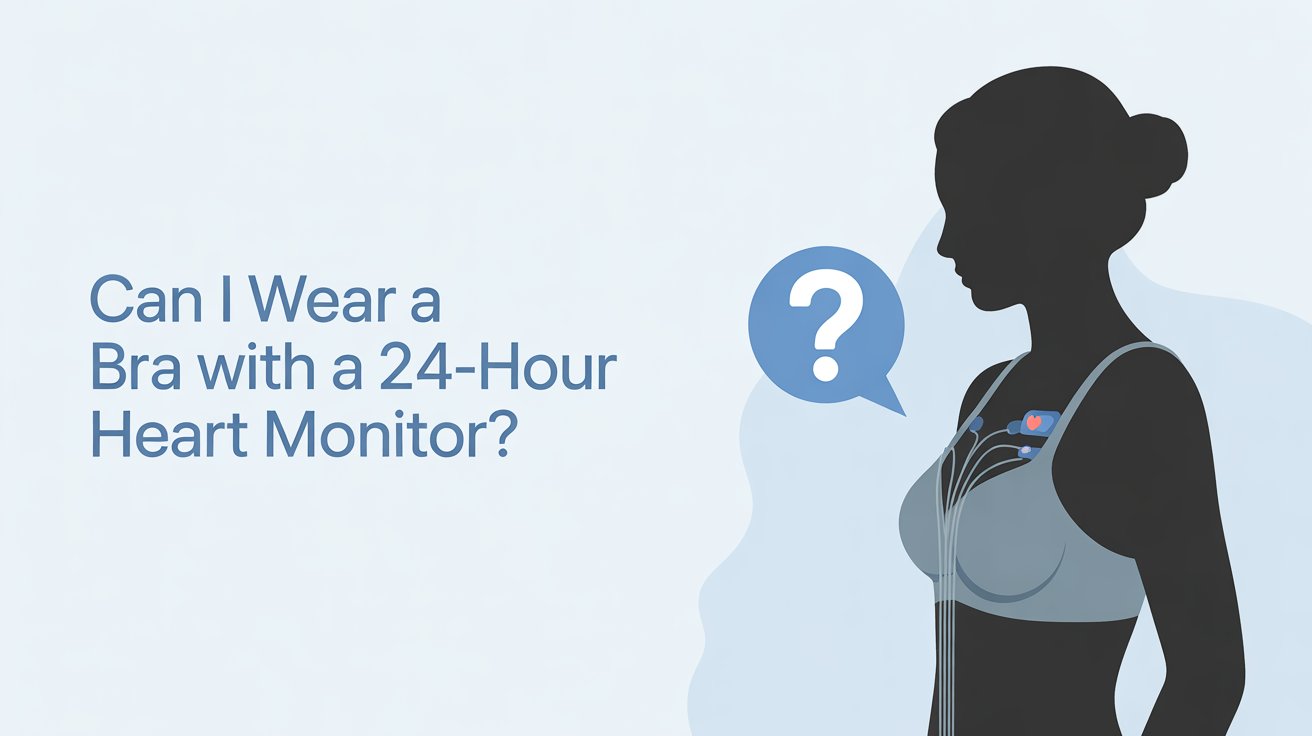
If you have been told you need a 24-hour heart monitor, your first question might be practical rather than medical: what on earth do I wear? It is one of the most commonly searched questions about Holter monitoring — and one that almost nobody answers directly.
The honest answer is reassuring. Wearing a heart monitor for 24 hours does not have to be uncomfortable, inconvenient, or disruptive to your normal routine. With the right preparation and the right choice of clothing, most women find the experience far more manageable than they expected.
This guide answers the bra question clearly, then covers everything else you need to know about clothing and daily life with a 24-hour heart monitor — so you can go into your appointment feeling prepared rather than anxious.
If you are experiencing palpitations, dizziness, or chest discomfort and have not yet had a cardiac assessment, our ECG heart health check-up at The Private GP is a prompt first step — results reviewed on the same day, no waiting list.
What Is a 24-Hour Heart Monitor and Why Might You Need One?
A 24-hour heart monitor — also known as a Holter monitor or ambulatory ECG — is a small, wearable device that records your heart’s electrical activity continuously while you go about your normal daily life. Unlike a standard ECG, which captures just a few seconds of heart activity in a clinic, the monitor runs all day and night, capturing rhythm problems that would never show up in a brief appointment.
The British Heart Foundation explains that it is used as a continuously recording ECG, typically for 24 to 48 hours, to help diagnose the cause of symptoms such as palpitations that are not constant and rarely happen when a patient is sitting in their GP’s surgery.
Gateshead Health NHS confirms that a Holter monitor is arranged for people suspected of having frequent heart arrhythmias — including collapses, palpitations, or dizziness — and is also commonly used for people who have had a recent stroke or mini stroke.
The device itself is roughly the size of a mobile phone and is clipped to a belt or waistband. Wires connect it to three sticky electrode patches placed on your chest. The whole fitting appointment takes around 10 to 15 minutes, and once fitted, you carry on with your day as normal — the monitor records everything automatically.
You do not need to press a button or do anything special. You will be asked to keep a diary of your activities and any symptoms you notice, so your doctor can match what your heart was doing with what you were feeling at the time.
Can You Wear a Bra With a 24-Hour Heart Monitor?
Yes. Multiple NHS trusts are explicit on this point: women may keep their bras on during fitting and throughout the monitoring period.
West Suffolk NHS Hospital’s patient leaflet on 24-hour ECG monitoring states directly that you will be asked to remove your clothing above the waist, and that ladies may leave their bras on. Royal Papworth Hospital NHS Foundation Trust uses the same wording in their patient information.
The key question is not whether you can wear a bra — you can — but which type of bra is most suitable.
The London Heart Clinic advises that during the fitting appointment, women will need to remove a wired bra, but may be able to keep wearing their bra if it is unwired or a sports bra. The concern with underwired bras is that the rigid metal underwire can press directly against the electrode patches on your chest, which may cause discomfort and could potentially affect how well the electrodes adhere to your skin over 24 hours. The underwire does not interfere with the electrical recording in the way that a metal implant might, but its pressure on the adhesive patches is the practical problem.
The good news is that a wireless bra or soft-cup bra works perfectly well, is entirely safe to wear, and will not compromise the recording in any way.
What Type of Bra Is Best to Wear With a Heart Monitor?
Choosing the right bra before your appointment makes the whole 24 hours considerably more comfortable. Here is what works well and what to avoid.
Wireless bras are the most straightforward option. Without underwire, there is nothing rigid to press on the electrode patches. Soft-cup wireless bras in breathable cotton or modal fabrics are ideal — comfortable for extended wear and gentle against the skin around the electrode sites.
Sports bras are another excellent choice. Research into Holter monitor comfort confirms that sports bras are often the most comfortable option because they provide gentle, even support without underwire that might press against electrodes. The snug but flexible fit also helps keep the wires in place and prevents them from pulling on the electrode patches as you move. Make sure your sports bra is not excessively tight, as a very constricting band could press on lower chest electrodes.
Front-fastening bras are worth considering for practical reasons. Getting dressed and undressed over 24 hours without pulling clothing over your head — which risks disturbing the electrodes and wires — is much easier with a front clasp or front zip.
What to avoid:
Underwired bras are best left at home for the day. The rigid underwire sits directly over the area where several of the chest electrodes are placed and can lift or loosen them over time.
Strapless bras are also not ideal, as they tend to shift position more easily and provide less stable support for the monitor wires throughout the day.
Very tight bras with a firm, wide band that sits across the lower chest can put pressure on electrodes positioned below the breast line, so opt for something with a softer, more flexible band if you can.
Breathable, natural fabrics such as cotton are preferable to synthetic materials, which can cause sweating around the electrode sites and reduce adhesion over the course of the day.
What Else Should You Wear During 24-Hour Heart Monitoring?
Your clothing choices for the full 24 hours matter almost as much as your bra. The goal is comfort, practicality, and keeping the electrodes securely in place.
East Suffolk and North Essex NHS Foundation Trust advises that patients should wear loose-fitting clothes that are easily removable from the waist up when attending their fitting appointment. This advice holds throughout the monitoring period.
Tops: Choose loose, soft tops that do not cling tightly to your chest. Button-down shirts, cardigans, or zip-up tops are practical choices because you can open them from the front without pulling anything over your head. A loose-fitting t-shirt works well for around the house. The wires that run from the electrodes to the monitor can be tucked discreetly beneath your clothing, so if you would rather no one notices you are wearing a monitor, layering with a cardigan or loose blouse makes this straightforward.
Bottoms: Comfortable trousers, leggings, or a skirt — whatever you normally wear. The monitor clips to your waistband or sits in a pocket, so waistbands that are not excessively tight make this more comfortable.
Metal: Avoid clothing with metal buttons, buckles, or zips across the chest area. There is no need to remove jewellery such as earrings or a necklace, but avoid wearing anything metallic directly over the chest where the electrodes sit.
Sleeping: You wear the monitor overnight. For bed, a loose pyjama top or nightshirt that fastens at the front works well. The monitor can be placed beside you on the mattress or tucked under your pillow. Your clinician will advise on the best approach at the time of fitting.
The day before: Do not apply lotion, oil, or talcum powder to your chest on the day of your fitting appointment. These reduce how well the electrodes stick to your skin, which can lead to a poor-quality recording or electrodes that come loose during the day.
What Can You Not Do With a 24-Hour Heart Monitor?
The main restriction with a traditional wired Holter monitor is water. You cannot shower, bathe, or swim while the monitor is attached.
University Hospital Southampton’s patient information is clear: the monitor must be kept dry throughout the recording period. Getting the device wet will damage it and could invalidate your recording — meaning you may need to repeat the test. If you are wearing the monitor for longer than 24 hours, your clinician will give you spare electrodes and show you how to remove and reattach the device briefly for washing.
Modern patch-style monitors — a single adhesive unit that sticks directly to the chest without wires — are sometimes waterproof. Your clinician will tell you exactly which type of device you have been given and what it can and cannot tolerate.
Beyond the water restriction, both the NHS and clinical guidance are consistent that you should carry on with your normal daily routine whilst wearing the monitor. This is the entire point of the test. If you restrict your activity, rest more than usual, or avoid the things that normally trigger your symptoms, the recording may not capture what your doctor needs to see.
Walking, light exercise, going to work, cooking, shopping — all of these are fine. If you normally do more vigorous exercise, check with your clinician beforehand, as this may vary depending on your specific situation.
Keep your diary card with you and note down the time of any symptoms — a flutter, a dizzy spell, breathlessness, or chest discomfort. Also jot down your main activities and when you go to bed and wake up. This correlation between symptoms and heart rhythm is what allows your doctor to make a meaningful interpretation of the results.
What Happens After the 24 Hours?
Once the monitoring period is complete, you remove the monitor yourself — your clinician will show you how at the fitting appointment — and return the device and your diary card to the cardiology department. Most NHS trusts have a drop-off point at reception.
The data is then analysed by a cardiac physiologist and the results are sent to the doctor who referred you. On the NHS, this process typically takes several weeks from referral to results, depending on local waiting times.
If you are experiencing symptoms that concern you and want to be assessed promptly before a Holter monitor referral, The Private GP can help. Our ECG heart health check-up gives you an on-site ECG with results reviewed and discussed by a doctor on the same day. If your ECG identifies something that warrants further investigation, we can discuss next steps clearly, including whether ambulatory monitoring or additional tests are appropriate.
Frequently Asked Questions
- Can I wear an underwired bra with a Holter monitor?
It is best to avoid one if you can. The London Heart Clinic advises that wired bras should be removed during fitting. The metal underwire can press on the electrode patches attached to your chest, which may cause discomfort and potentially loosen the adhesive over the course of 24 hours. A wireless bra or sports bra is a much more comfortable and practical choice.
- Will my bra interfere with the heart monitor readings?
A well-chosen wireless or soft-cup bra will not interfere with your heart monitor readings at all. The electrodes on your chest record the electrical signals from your heart, and fabric does not affect this. The main concern with underwired bras is physical pressure on the electrode patches, not electrical interference. Wear something comfortable and the recording will be accurate.
- Can I exercise while wearing a 24-hour heart monitor?
Light to moderate exercise is generally fine and is actually encouraged, as the NHS confirms that carrying on with your normal daily routine is important for an accurate recording. If you normally do vigorous exercise such as running, swimming, or gym training, check with your clinician beforehand. Swimming is not permitted with traditional wired monitors, as the device must be kept dry.
- Can I shower with a 24-hour heart monitor?
No, not with a traditional wired Holter monitor. The device must be kept completely dry throughout the recording period, as water will damage it. If you are wearing the monitor for longer than 24 hours, you will be given spare electrodes and shown how to disconnect briefly for washing. Some modern patch-style monitors are waterproof — your clinician will tell you which type you have been given and what it can tolerate.
- What do I do if an electrode falls off?
Do not panic. Try to press the electrode patch gently back onto your skin as close to its original position as possible. Make sure the skin is dry before reattaching it. Note the time in your diary. If the electrode will not reattach, call the cardiology department for advice — contact details will be on your appointment information. Losing contact on one electrode briefly does not usually ruin the entire recording, but it is worth noting in your diary so your clinician can account for it when reading the results.